Comparing forecasts with reality
Long before BER opened, forecasts were made of the expected aircraft noise levels, and these were used to define noise protection zones where residents are entitled to noise protection. An assessment is currently underway to determine whether the forecasts are accurate and whether the noise protection zones are sufficiently large. The review was originally scheduled to take place one year after BER opened, but was postponed following consultation with the Joint Higher Aviation Authority Berlin-Brandenburg (LuBB). The main reasons for this were that, due to the coronavirus pandemic, the number of flight movements remained well below expected levels for a long time, and that Air Traffic Control Germany was also carrying out a validation of BER’s flight routes.
Nevertheless, FBB is monitoring the development of aircraft noise very closely and publishes the current measurement data for the various noise protection areas here (in German).
When comparing the measurements and forecasts to date, it should be noted that the figures given for each monitoring point represent the highest monthly values recorded since BER opened. For the pending review of the protection zones, however, the values from the six busiest months will be used.
Daytime protection and outdoor
living areas
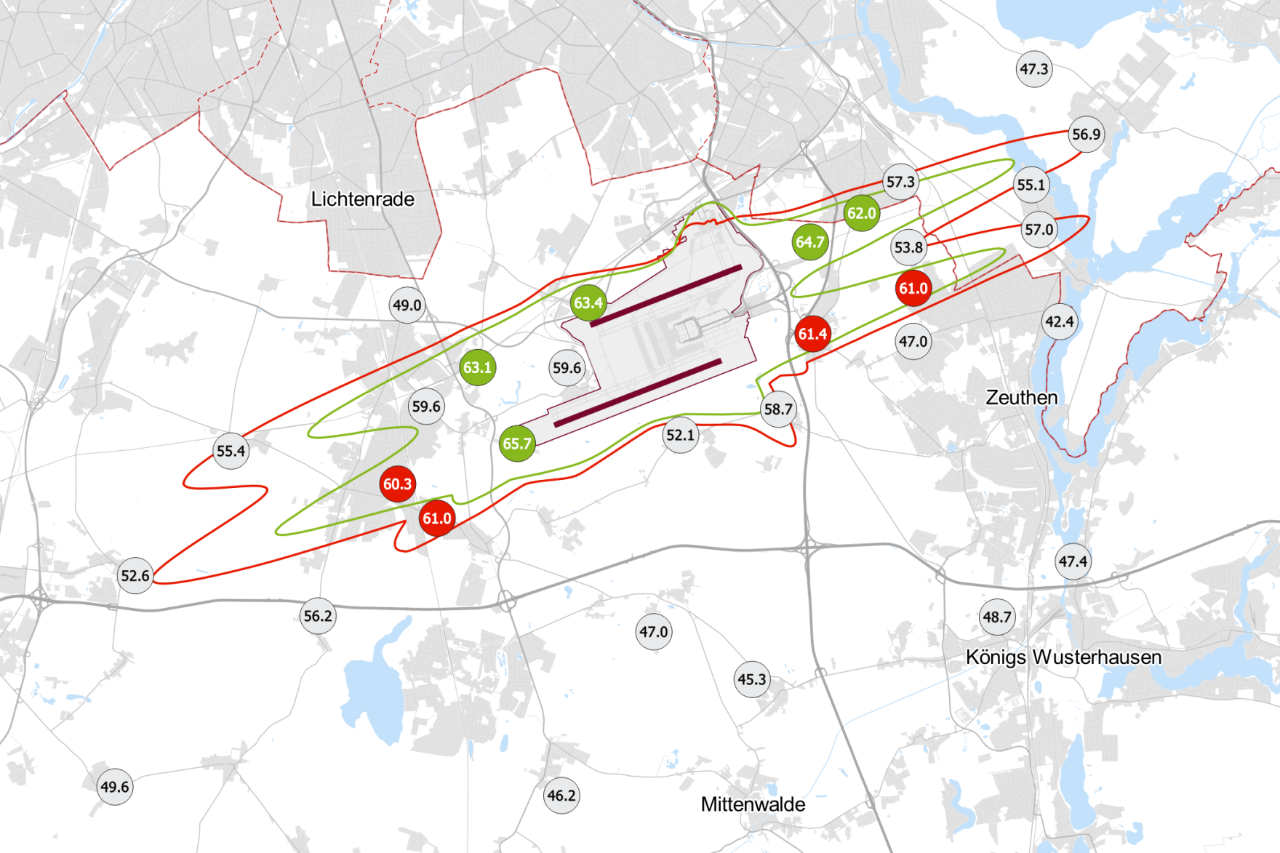
The first map compares the aircraft noise forecast and the highest monthly figures recorded to date for the daytime protection area and the outdoor living area compensation area.
The red contour shows the daytime protection area:
- Rooms used during the day are entitled to noise protection here
- Forecast based on 60 dB(A) continual sound level within the contour
Green contour shows the area for compensation for outdoor living areas:
- Here there is an entitlement to compensation for balconies and terraces
- Forecast based on 62 dB(A) continual sound level within the contour
The differently coloured circles mark the aircraft noise measurement points with the highest monthly figures recorded to date. Insofar as the forecast of 60 or 62 dB(A) was achieved, the measuring points are coloured red (daytime protection) or green (outdoor living area compensation). For measuring points coloured grey, the aircraft noise has so far been below the forecast. The fact that all measuring points outside the contours are grey also makes it clear that the continual sound levels here are below 60 or 62 dB(A) and that the protected areas are, therefore, sufficiently large.
Measured values are significantly below the forecast in some cases
Night-time protection
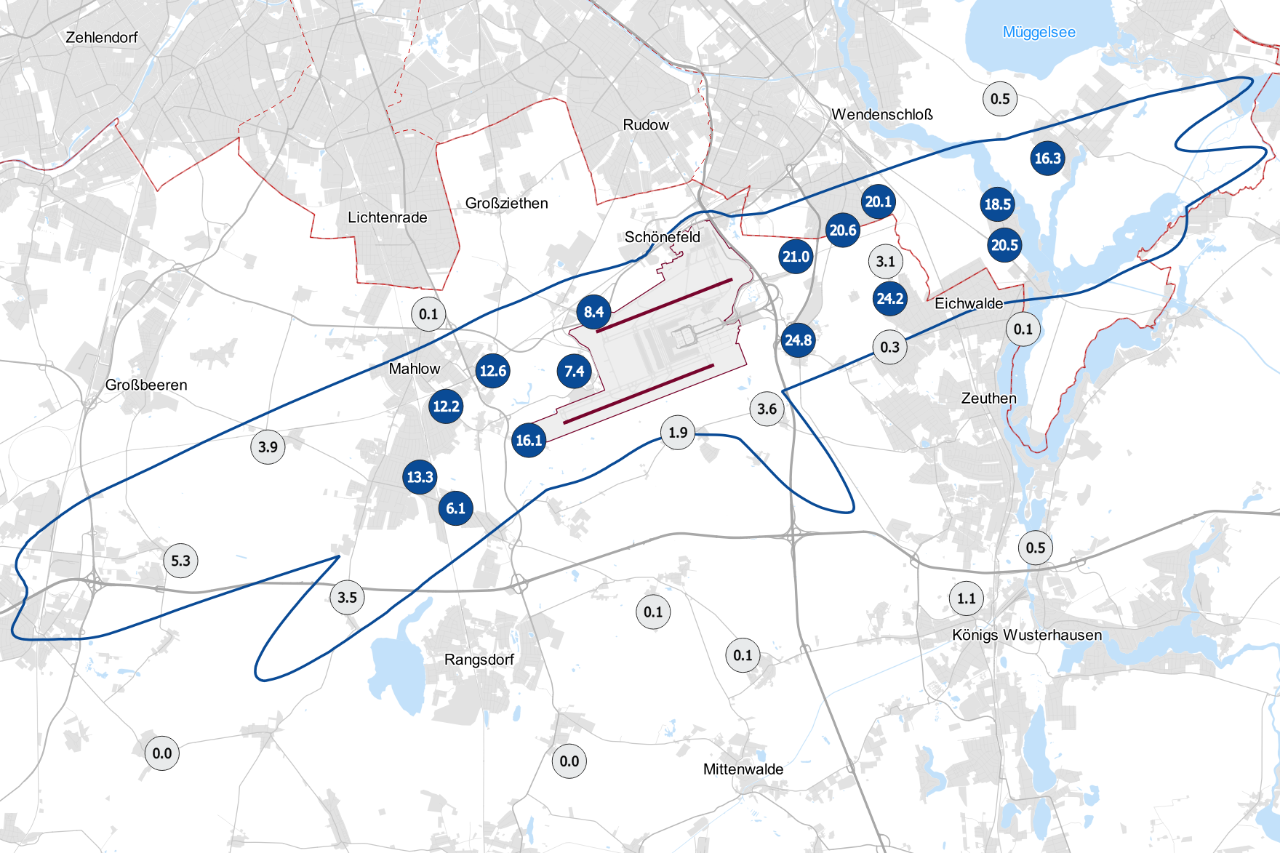
The second map compares the aircraft noise forecast and the highest monthly figures recorded to date for the night protection area.
The blue contour shows the night protection zone:
- Areas used at night are entitled to noise protection here
- Forecast based on 50 dB(A) continual sound level within the contour
- Forecast assumed 6 cases in which 70 dB(A) were exceeded on average at night
The differently coloured circles mark the aircraft noise measurement points with the highest monthly figures recorded to date. The measuring points are coloured blue insofar as the forecast of 50 dB(A) has been reached. If the measuring points are coloured grey, the previous aircraft noise is below the forecast. The fact that all measuring points outside the contours are grey shows that the continual noise levels here are below 50 dB(A) and, therefore, no adjustments to the night protection area are required.
Aircraft noise not higher than expected
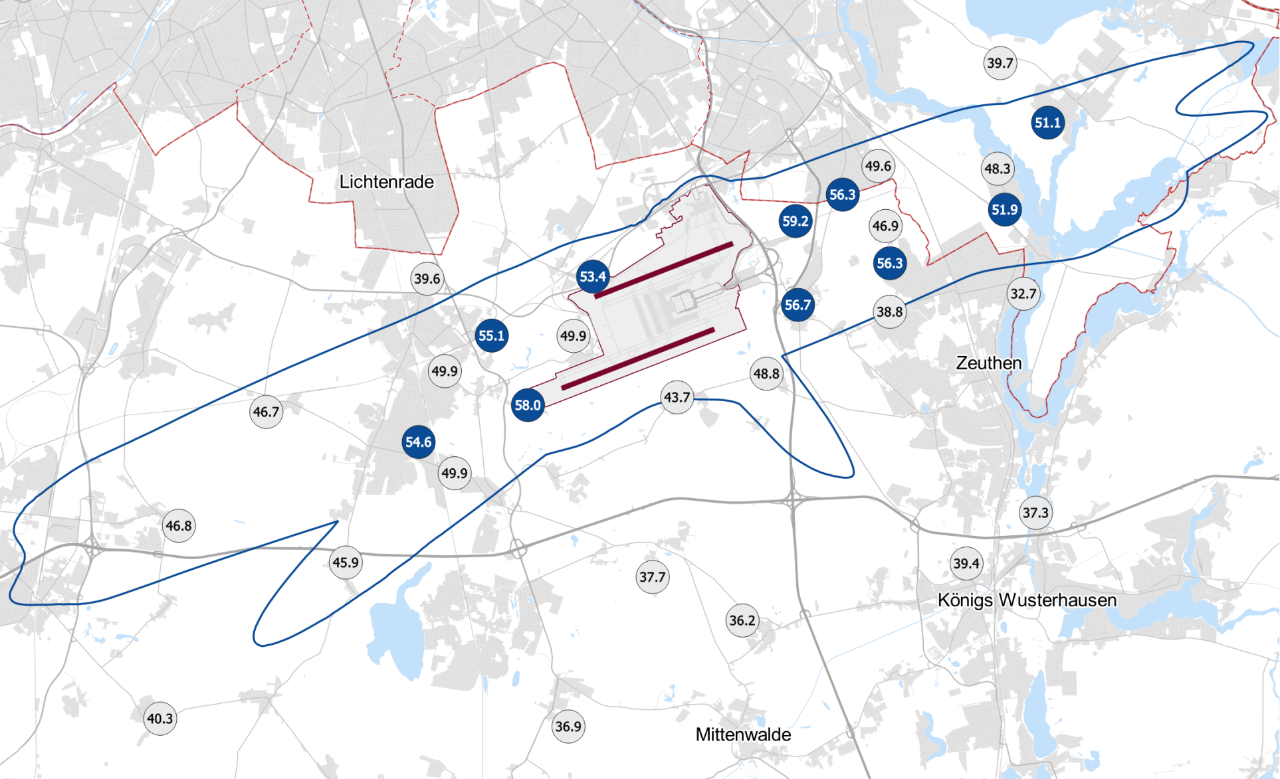
The third map shows the number of times the 70 dB(A) limit was exceeded by aircraft during an average night. The measurement points indicate the average number of times the 70 dB(A) limit was exceeded per night during the noisiest months to date. Where the measurement points are coloured blue, the criteria for night-time noise protection have been met so far. Outside the contour, there are only grey monitoring points; here, 70 dB(A) has so far been exceeded less than once per average night everywhere.
Very few noisy night flights outside the night protection zone
How to reach us:
-
 Airport information (24/7)
 -
 Find the right contact


