Underlying conditions and
current status
Legal basis
The “Expansion of Schönefeld Airport” planning approval decision of 13 August 2004 (PFB) is the key legal basis for BER Airport and, therefore, also for the BER Noise Abatement Programme. Among other things, the PFB contains legal requirements regarding noise protection targets, measures and areas of entitlement.
Further information on the planning approval decision can be found on the website of Joint Aviation Authority Berlin-Brandenburg (LuBB) (in German).
Protected areas and protection goals
Predicted noise levels for the protected areas
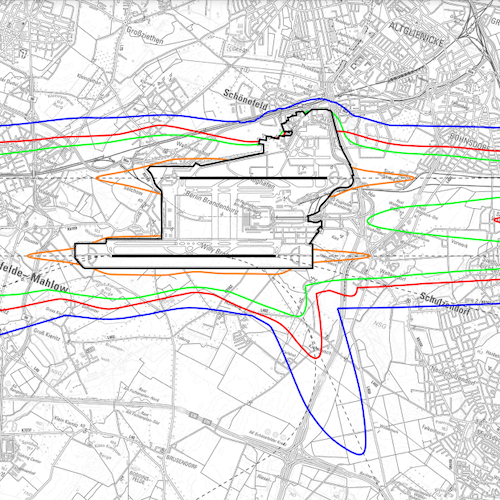
The extent of the various protected areas was calculated and marked using contours. Calculations were also made for the day and night protection areas to forecast which aircraft noise levels are to be expected at which location.
- A continual noise level of at least 60 dB(A) was forecast for this area
- All rooms used for living and working (living room, children’s room and guest room) are entitled to noise protection
- Two maps each show the forecast of the maximum and continual sound levels for a current aircraft mix and an old aircraft mix
- The maximum and continual noise levels with the old aircraft mix are very high, but cannot be compared with reality because they include a large number of old long-haul aircraft that do not fly at BER
Maximum level daytime protection (new mix)
Continual noise level daytime protection (new mix)
- In this area, either a continual noise level of at least 50 dB(A) or six flights with a volume of at least 70 dB(A) for each average night were predicted
- All rooms used for sleeping (bedrooms and children’s rooms) are entitled to noise protection
- Four maps each show the forecast of maximum and continual noise levels for a current aircraft mix and an old aircraft mix
- As in the case of daytime protection, the maximum and continual sound levels predicted with the old aircraft mix are significantly higher than in reality
Continual noise level night protection (new mix)
Maximum level night protection (new mix)
Continual noise level night protection FlugLSV (new mix)
Maximum noise level night protection FlugLSV (new mix)
Continual noise level night protection (old mix)
Maximum noise level night protection (old mix)
- In this area, a continual noise level of at least 62 dB(A) was forecast
- Counter measures are granted for outdoor living areas such as terraces or balconies
- In this area, a continual noise level of at least 70 dB(A) was forecast
- In this area, FBB must purchase the properties from owners if they so wish
Protection goals
The protection goals for the BER noise protection programme specify the requirements that need to be met by implementing noise protection measures. In that respect, different requirements apply for the day protection area and the night protection area. While the protection targets that apply in the night protection area are also common at other German airports, the requirements in the day protection area extend significantly further and often reach the limits of what is technically feasible.
- Daytime protection goal
- Protection goal at night
A maximum level of 55 dB(A) may be exceeded inside living areas less than once in the 180 busiest days. In mathematical terms, this results in less than 0.005 cases of exceeding 55 dB(A) each day.
Inside the bedrooms, a maximum level of 55 dB(A) may not be exceeded more than 6 times each average night. In mathematical terms, this results in less than 6 cases of exceeding 55 dB(A) each night. Suitable ventilation equipment is required if this is only possible with closed windows.
Localities
Various localities are completely or partially located in the protection and counter measure area of BER Airport. These localities include:
- Berlin-Bohnsdorf
- Berlin-Müggelheim
- Berlin-Rahnsdorf
- Blankenfelde-Mahlow
- Dahlewitz
- Diedersdorf
- Eichwalde
- Genshagen
- Glasow
- Gosen
- Jühnsdorf
- Karlshof
- Karolinenhof
- Kiekebusch
- Ludwigsfelde
- Rotberg
- Schmöckwitz
- Schulzendorf
- Selchow
- Siedlung Hubertus
- Siedlung Waltersdorf
- Waltersdorf
- Waßmannsdorf
Current reports
The current noise protection reports (in German) can be found here.
Protection of special facilities
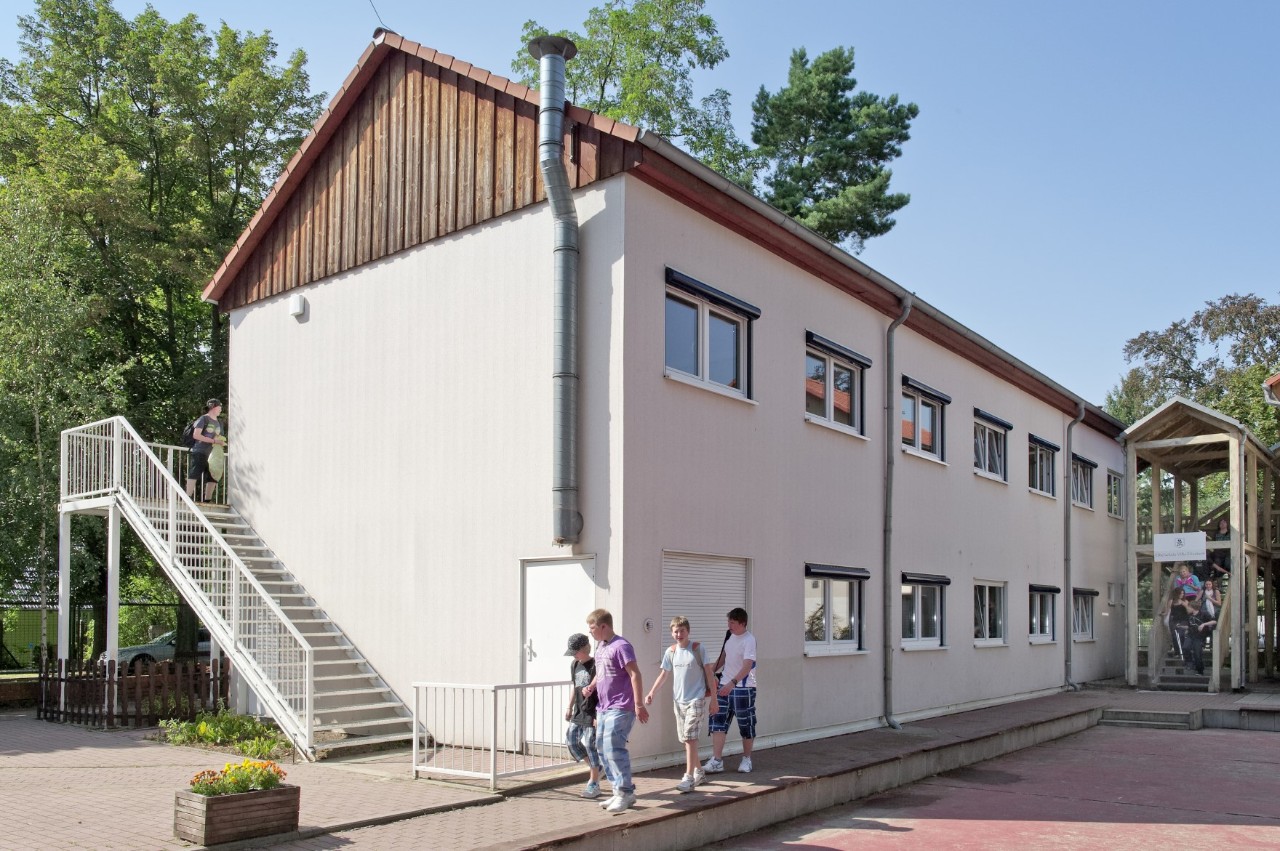
Flughafen Berlin Brandenburg GmbH (FBB) is adopting noise protection measures in particularly vulnerable facilities such as daycare centres, schools and retirement homes.
For example, FBB has installed soundproof windows with special fans in the Humboldt primary school in Eichwalde at a cost of almost 500,000 euros. The Ingeborg Feustel primary school in Blankenfelde is a further example. Here, windows were replaced and 24 rooms were equipped with ventilation. The costs, totalling some 350,000 euros, were borne entirely by FBB.
Applications for sound insulation have already been submitted for a total of 49 special facilities. The construction work has been completed in 45 facilities, while work still needs to be performed in four facilities. FBB has already invested about 20 million euros in the protection of special facilities.
How to reach us:
-
 Airport information (24/7)
 -
 Find the right contact


