Noise protection for new buildings
Despite aircraft noise, more and more flats and homes are being built in the vicinity of BER, which raises many questions about noise protection for new buildings. Future home owners should ensure that their homes have adequate noise protection when they are built and inform the airport company (FBB) as early as possible about the plans to build a house.
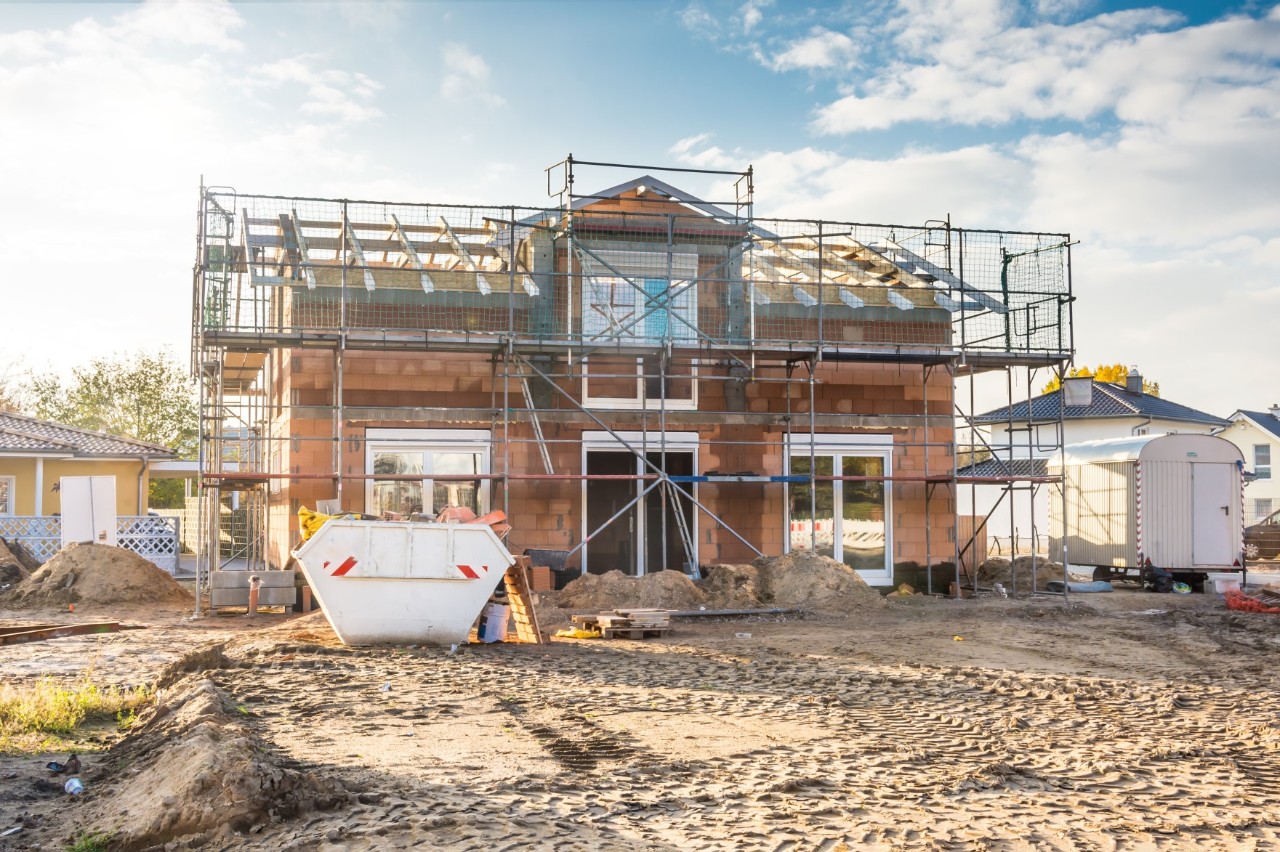
The matters that need to be considered when building a house in the vicinity of the airport and how FBB can support future home owners during construction are described below.
However, it should be noted that the new building must be occupied by 4 November 2025 at the latest to receive noise protection. The background to this is the deadlines applicable to the BER noise protection programme, according to which claims can be asserted up to a maximum of five years after BER is commissioned.
Is the property located within the noise protection areas of the BER noise protection programme?
With just a few mouse clicks, the online tool TraVis (TrackVisualisation) can be used to determine whether or not a plot of land, or property, is located in the noise protection area. To do this, the noise protection areas can first be displayed in TraVis by clicking on them in the menu ribbon on the left. In the next step, the location of the property can be found by entering the address. To do this, simply enter the address at the top of the page or place the small house icon to the left of it on the map.
Is the plot of land also located in the BER noise protection zone?
In addition to the noise protection areas mentioned above, which are set out in the BER noise protection programme, the German Aircraft Noise Protection Act also applies at BER, as is the case at other German airports.
Documents and explanations in respect of the noise protection area (external website in German)
Insofar as a property is located in the noise protection area of BER, the German Aircraft Noise Protection Act requires owners to ensure that noise protection measures are implemented to protect against aircraft noise during the construction of the new building. In such a case, a noise protection certificate (LSB certificate) must also have been issued. The corresponding requirements are defined in the Second Ordinance on the Implementation of the Aircraft Noise Protection Act (2nd FlugLSV).
It should be noted here that the noise protection measures in the BER noise protection programme may extend beyond the German Aircraft Noise Abatement Act. Therefore, early coordination with FBB is absolutely necessary. FBB must be involved as early as possible in the planning of a new building to support owners in the construction of a soundproof new building.
In addition to the location in the noise protection areas, further requirements need to be met for a property to be eligible for noise protection. For example, the property must already have been built, or be capable of being built, by 15 May 2000. FBB shall review whether or not these and other requirements are met as soon as an application for noise protection has been submitted.
FBB offers individual agreements to owners who wish to build in the BER day protection area. By way of this agreement, owners can find out the costs that FBB shall bear for the new building before construction begins. Please note that the costs shall be paid as soon as the new building is occupied.
Download application form (in German)
FBB can reimburse suitable ventilation equipment retrospectively for new buildings constructed in the night protection zone. This is subject to the prerequisite that the new building has a standard building structure.
The owners receive the relevant aircraft noise levels for the property from FBB. On this basis, the new building can then be planned in such a way that the applicable noise protection goals are met with the help of noise protection measures. Owners should be aware that very strict requirements apply to noise protection at BER, particularly in the daytime protection zone, and that very extensive noise protection measures may be required as a result.
FBB has developed a guideline for new buildings to support owners or their planners in the planning of a soundproofed new building. In addition to the basic principles of the BER noise protection programme, this guide also contains information about the determination and planning of structural noise protection measures.
are met with the help of noise protection measures. Owners should be aware that very strict requirements apply to noise protection at BER, particularly in the daytime protection zone, and that very extensive noise protection measures may be required as a result.
FBB has developed a guideline for new buildings to support owners or their planners in the planning of a soundproofed new building. In addition to the basic principles of the BER noise protection programme, this guide also contains information about the determination and planning of structural noise protection measures.
Owners should inform their planner at an early stage that special noise protection requirements apply to new buildings in the noise protection areas. These requirements must be met so that an individual agreement can be reached between the owners and FBB.
As soon as the plans for the soundproofed new building are available, owners should submit them to FBB. FBB also requires floor plans that clearly show the future use of the individual rooms. Similarly, FBB requires the completed forms A1, A2 and B to identify the sound insulation measures that are required and the resulting reimbursement amount.
It should be noted here that the plans must clearly show that the protection targets applicable to noise protection at BER Airport are met. The owners and FBB can only enter into an individual agreement if this requirement is met.
Annex A1 - Sound insulation measures for rooms used during the day (in German)
Annex A2 - Sound insulation measures for rooms used during the night (in German)
Annex B - Determination of reimbursement amount (in German)
Once the plausibility of the planning has been reviewed, FBB determines the additional costs required to comply with the protection goals based on a current expert construction price calculation. In that respect, FBB calculates the difference between the cost of the planned new building with noise protection measures and a fictitious equivalent new building without noise protection measures.
These differential costs are included in the individual agreement that FBB offers the owners. The costs can be reimbursed as soon as the new building has been constructed as planned.
Upon receipt of the individual agreement, the owners know which costs FBB shall reimburse once the new building has been realised and occupied in accordance with the planning.
As a result, FBB requires information from the owners as soon as they have moved into the new building. The owners also need to confirm that the building has been realised in accordance with the plans and includes the necessary noise protection measures. FBB disburses the sum agreed in the individual agreement, subject to a review of the utilisation of funds or an on-site inventory.
Various reasons may apply why an individual agreement is not entered into. For example, FBB cannot offer an individual agreement to owners who only get in touch after construction has started. It is also conceivable that owners contact FBB in good time but do not wish to accept the individual agreement offered. In such cases, the following situation arises.
If a completed new building has sufficient noise protection, FBB will subsequently reimburse the costs incurred in addition to the costs incurred anyway.
However, if a new building does not have sufficient noise protection measures, further construction measures, such as new noise protection windows, must be implemented on the recently completed building. In such case, FBB would reimburse the difference after installation in costs that would have been incurred for the installation of a standard window (e.g. with a sound insulation of 32 decibels).
How to reach us:
-
 Airport information (24/7)
 -
 Find the right contact


